Tuesday, July 30, 2013

Mothers are Dying in Childbirth in the US

While researching for an NPR interview, I found an inspiring project online called The Safe Motherhood Quilt Project. The woman who is in charge of this project is collecting the names and stories of women who died due to complications in childbirth (or late-term abortion) to bring attention to the horrible maternal mortality rate here in the US. The United States spends more on medicine than nearly anyone else, but we have the highest infant and maternal mortality rate in the industrialized world. Where is all of that money going if it's not to save infants and mothers lives?

There are many reasons why this is happening. Here I list only a few:

1) The overuse of c-sections. Even in a scheduled routine c-section, the mother is twice as likely to die than if she had a vaginal birth.

2) Poor health care for poor people. Women living in poverty are far more likely to die from complications in childbirth than rich women.

3) Poorly staffed medical facilities and poor communication among staff. Many times when a woman dies in childbirth it is because the signs that something was wrong were not noticed or not reported until it was too late. I know medical personnel are only human and they take their jobs very seriously, but they need the support and the tools to do their job better.

For more information: Amnesty International Report


Monday, July 29, 2013

Lumen Fidei #10: Love is not an Emotion

Source
From #27: Love cannot be reduced to an ephemeral emotion.
I don't need to reinvent the wheel, so here is a link to my article I posted a while back on YOUCATholic.com.

To read more of this series about Pope Francis' first encyclical, go here.

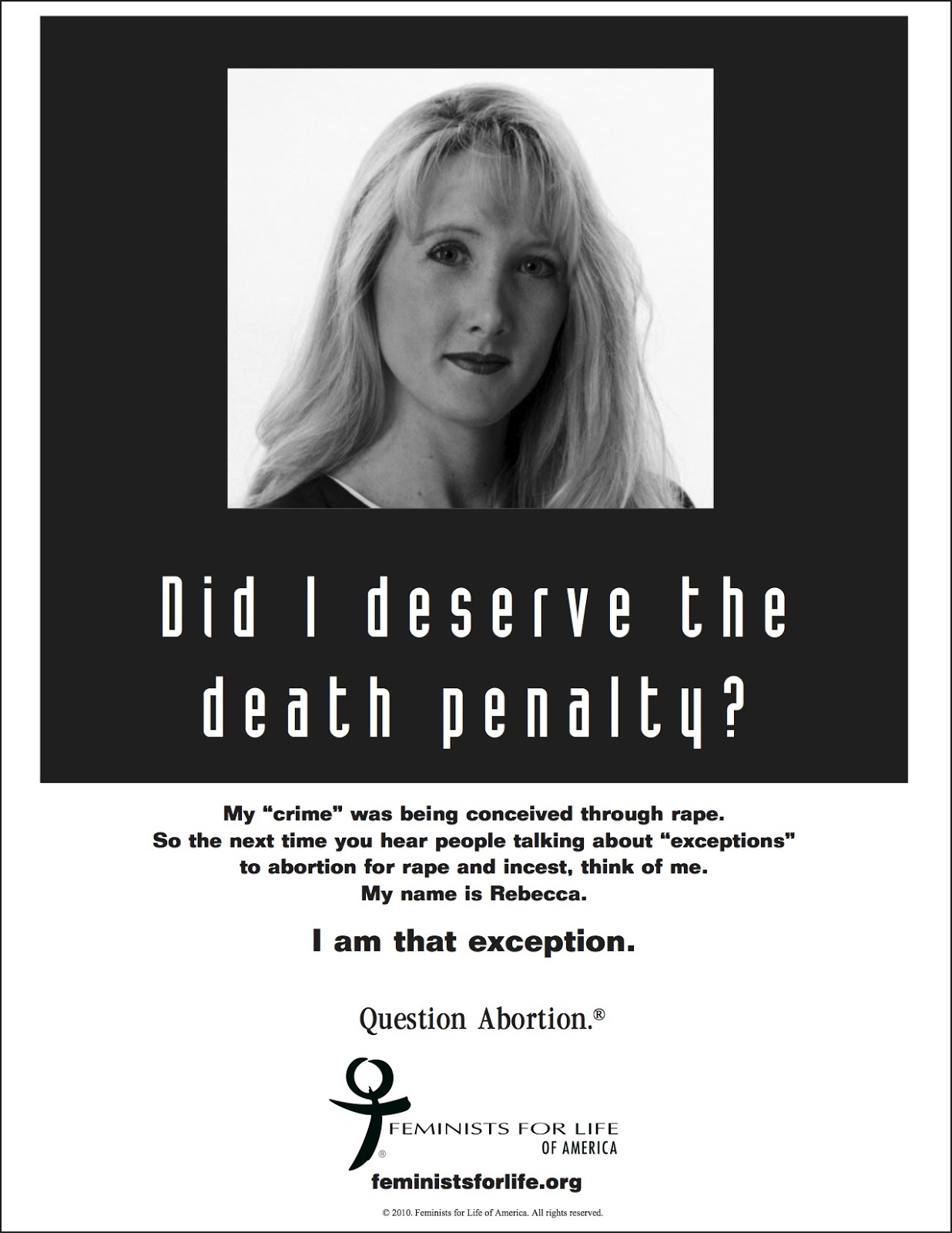
Eleven-Year-Old Reopens Abortion Debate in Chile

Right now, a debate rages in Chile.* Abortion is illegal there, but we have learned recently of an 11-year-old girl who is pregnant from years of abuse in the hands of her mother's boyfriend. She wants to keep the child. Pro-choice activists are using her case to fight for abortion rights.

Of course, unless it's in self-defense, I'm not all for killing the "terrorists" either.
So, would the pro-choice people force her to have an abortion? Arguably, she is not old enough to make a choice. She wasn't old enough to have her virginity stolen from her (or to consent). But she has other options. She could give the child up in an open adoption so that she could watch the child grow up without being financially responsible for him or her. It's also possible that a family member could adopt the baby so she could help raise the child without having the main responsibility for him or her. Those are just two of her options.

But the bottom line here is that it's not the child's fault that his or her father committed such a barbarous act. I hope the rapist gets punished to the fullest extent of the law. I hope the girl gets protected from further acts of violence and her mother's stupidity. Her mother is defending the rapist for crying out loud. But the unborn child doesn't deserve the death penalty.


I do not know any of her medical specifics so I know nothing about her physical ability to give birth to the child. I'd have to trust the doctors caring for her. My understanding is that Chile has some of the best maternity care in this hemisphere, unlike the US...

That rant is coming soon.

*For those who want to hear about it from a secular source, here is the CNN article.

Sunday, July 28, 2013

Lumen Fidei #9: The Need for Knowledge

Knowledge

From #24: ...we need knowledge, we need truth, because without these we cannot stand firm, we cannot move forward.
How do we know what is real? Without a firm grasp of what is real, we cannot really interact with the world around us. An example that was used frequently in my philosophy classes was:
We need to have an idea of what is real to even get out of bed in the morning. When you swing your legs over to get out of bed, you have to trust that there is a floor there that will hold you up.
Reality cannot be completely subjective or there will be chaos. There has to be an up and down, a right and wrong, a true and false. Otherwise, we cannot get out of bed in the morning, much less make any real choices, changes, or movement in our lives.

To read more of this series on Pope Francis' first encyclical, go here.

Friday, July 26, 2013

The Church's Strange Relationship with Apocryphal Literature

Today is the feast day of Mary's parents, Sts. Joachim and Anne. Thinking of them reminds me of this icon I saw a while back in a blog post by Christopher West:

Source that TOB Institute credits
In the post, he talks about how this icon illustrates for him the beauty of chaste marital love. In this icon, you see the saints embracing and in the background is a bed. It is supposed to depict the great mystery which is Mary's Immaculate Conception.

What is that? Catholics believe that Mary, the virgin Mother of God, was conceived without original sin. Original sin is a stain that we are all born with from Adam and Eve's fall in the garden. Mary was conceived without this sin because she was destined to be the Mother of God. God cannot be in the presence of sin, so His earthly vessel, Mary, had to be without sin. This is also credited to Jesus' sacrifice on the cross. As time is no barrier to God, Jesus' sacrifice made His mother's sinlessness possible. We are all redeemed through Christ including those who were born before He was.

Now, Joachim and Anne are not mentioned in the Bible. How do we know who they are? That is where this gets fun because I get to play Bible scholar again.


We are told in every other History Channel Bible special that the big, bad Catholic Church suppressed the wonderful literature found in the apocryphal gospels. This feast day is a prime example of how wrong that is.

Joachim and Anne's names and everything else we know about them comes from an apocryphal book. Yes, you read that correctly.

The book is called the Protoevangelium of James. "Protoevangelium" is just a fancy word for "pre-Gospel." The book is a "pre-Gospel" because most of it revolves around things that happened before Jesus' birth like the childhood of Mary and the events of Jesus' early life like running from Herod.

Ever seen a statue or a picture of St. Joseph holding a staff with a lily, like so?

Source
That comes from the same book. At one point, it tells the story of how St. Joseph came to be betrothed to Mary. The story goes that St. Joseph and other widowers brought their staffs to the temple. St. Joseph's staff bloomed, indicating that he was the one chosen by God to take Mary as his wife.

So it seems that the Church didn't suppress the apocryphal gospels at all, but incorporated some of their legends into it's rich treasury.

So, how was the New Testament established if it wasn't some judgement pontificated from on high? (Pun completely intentional.)

It was an organic process over the first few centuries of Christianity. As Christianity grew, groups of Christians used a wide variety of texts based on what the group's views were and whatever was available in their time and place. Over time, it became apparent that if Christianity was to survive, they needed some kind of standard. They used a variety of standards to determine what would eventually become part of the New Testament canon:

1) There were several books that were widely used by most groups. Those books were mostly shoe-ins.

2) Preference was given to books that contained stories told by the apostles themselves.
3) Also, they stuck to books that were similar. Books that contained bizarre stories or doctrine not found anywhere else were thrown out.

But no books were suppressed. Over the first 4 centuries when these decisions were being made, Christianity itself was being suppressed and persecuted. No one Christian group had the power or the visibility to suppress another.

When Christianity did become institutionalized, certain groups that used these writings were suppressed, but the writings themselves were not.

In short, it wasn't ever about power, but about the need for standardization. But that isn't what we're taught because it isn't neat and tidy. It's much easier to blame the Church. Anything organic is messy and takes a lot longer to explain.


Thursday, July 25, 2013

Lawn Chair Catechism #9: Life (and Conversion) is Messy

This is my contribution to a conversation happening on Catholicmom.com about Sherry Weddell's book Forming Intentional Disciples. This book has been eye-opening for me. I highly recommend it and it's never too late to join the conversation.


I found it very liberating earlier in the book when Weddell points out that the stages of conversion are not always in order and we are always bouncing around.

I know I've been in the intentional disciple phase before, but I know I'm not now.

I would now put myself back maybe as early as "Trust."

So, it hit home in this chapter in the end when it talks about people in leadership positions who are not yet disciples.

As one of those leaders, I cannot speak to whether or not I can treat others in my shoes graciously. I'm one of the ones who need that patience.


Life is messy. Nothing ever goes in a straight line. Often, we do not get a resolution or closure. We hardly ever get what we think we want. And our relationship with God is much the same way.

When I was looking up images for this, I was struck by this one:

Stolen from a very interesting blog post.
As a graduate theology student, I didn't really care about theory unless it had some application to reality. What good is it to know the complexities of the Trinity if it has nothing to do with people's everyday life? Life needs to feed theology and theology needs to feed life. Otherwise, both are pointless.

And both are messy. We are imperfect people relating to a perfect Creator. We are imperfect people fumbling through a confusing life dealing with other imperfect people.

Like the other relationships in your life, your relationship with God will not be on a straight trajectory. That's just not how humans work. Some days you'll be on a spiritual high, some days you'll be full of doubt, most days you'll be somewhere in-between.


I'm not really stressing about the fact that I'm at the "trust" phase.* I'm still working through it. I'm not sure if I'm pining after a community that doesn't exist and I just need to get over myself. Maybe I need to find my community in the Holy Trinity and the saints. Maybe I just need to grow up and realize that adults don't bond like young adults and kids do.

Source.
The kicker in all of this is I cannot give others what I don't have. At least I'm trying to develop my relationship with God. And, as I said, I've been an intentional disciple before. Does that count for something? I think it does. I think I do have something to share even in this stage.

Leaders who are not yet disciples do need to become disciples, but they don't have to quit in the short-term. Seeing leaders struggle gives hope to us all in our struggles. I've told people before, there are things that the Church teaches that I struggle with. And those who have heard of my struggles are comforted by the fact that someone-who-has-been-studying-religion-since-she-learned-how-to-read still has trouble. As long as those who are struggling don't intentionally mislead the flock, I think there is no reason why those who are struggling cannot stay in power.

What do you think?


*For those of you following at home, the "trust" phase is the first stage of conversion where a bridge is created between the person and the worshiping community. It is characterized as such, "Many don’t trust God or the Church, by they do trust a Christian in their life." (quote from chapter 5 of Forming Intentional Disciples)

Total Pageviews

Popular Posts